web
Stunt Double
Predictive user research platform using autonomous AI agents
Year
2026
Technologies
AI Agents, LLM Integration, TypeScript, Open Source, User Research, Testing
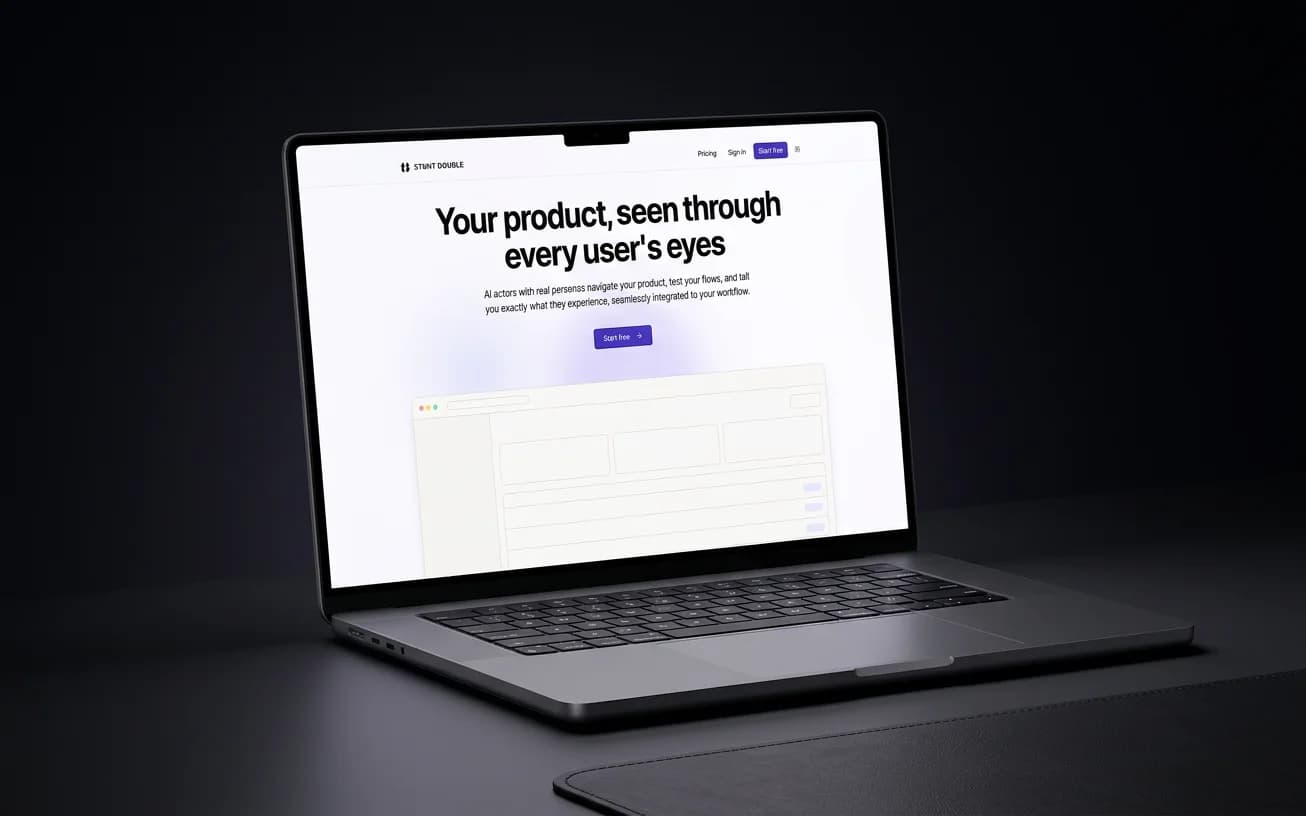
Stunt Double represents a paradigm shift in how we validate digital products. Rather than waiting for production traffic or scheduling expensive user interviews, I built a platform where AI agents act as realistic users to test journeys and provide predictive insights. It gives product teams a "dress rehearsal" for their code, identifying barriers and cognitive biases before a single real user encounters them.
The Challenge
Product development cycles often suffer from a critical feedback gap. Traditional A/B testing provides accurate data but arrives too late, after the code is shipped. Conversely, qualitative user research is invaluable but slow, expensive, and hard to scale.
The core problem I set out to solve was how to validate user journeys and optimizing conversion rates during the development process, not after. I needed to create synthetic users that were not just "click-bots," but agents capable of reasoning, experiencing friction, and providing evidence-based feedback on complex interfaces.
Approach
My approach centered on "Human Layer Technology", building agents that simulate diverse personas and interaction patterns. Unlike standard end-to-end testing frameworks that look for DOM elements to pass/fail a test, these agents needed to "see" and "understand" the page structure contextually.
To achieve this, I developed a model-agnostic architecture allowing integration with Claude and ChatGPT. A critical technical piece of this puzzle was handling how LLMs interpret web interfaces. I built and open-sourced @stdbl/wao, a tool that transforms messy websites into structured, semantic representations that LLM agents can reliably navigate and reason about.
I also prioritized workflow integration. Developers shouldn't have to leave their ecosystem to get feedback. I implemented deep integrations with Linear and Slack, allowing teams to mention @stuntdouble in a ticket to automatically trigger an agent analysis run.
Key Features
- Autonomous Agent Simulation: Agents that navigate websites with persistent memory and specific user personas.
- @stdbl/wao Engine: Custom open-source DOM transformation layer for superior LLM comprehension.
- Evidence-Based Reporting: Insights are delivered with screenshots, transcripts, and reasoning logs, not just generic advice.
- Ecosystem Integration: Native support for Linear, Slack, and a Figma plugin (Beta) to fit into existing workflows.
- Cognitive Bias Analysis: Agents specifically analyze flows for psychological friction points and conversion barriers.
Results
Stunt Double has enabled product teams to move from reactive fixing to proactive optimization. By treating AI agents as a new demographic of users, the platform validates accessibility and logic flaws that automated unit tests miss. The "Experience Ops" model allows teams to catch issues immediately, drastically shortening the feedback loop from weeks (user testing) to minutes (agent simulation).
Lessons and take-aways
- The DOM is messy for AI: Standard HTML is often too noisy for LLMs. Transforming the web into a "structured representation" via
@stdbl/waowas essential for agent reliability. - Context is King: For an agent to act like a user, it needs more than just a URL; it needs a persona, a goal, and knowledge of the domain.
- The Future is Hybrid: Building this platform highlighted that the future of the web will need to cater to both human users and AI agents acting on their behalf.